Frost's Quiet Work: The London Windscreen Chip That Becomes an MOT Bill
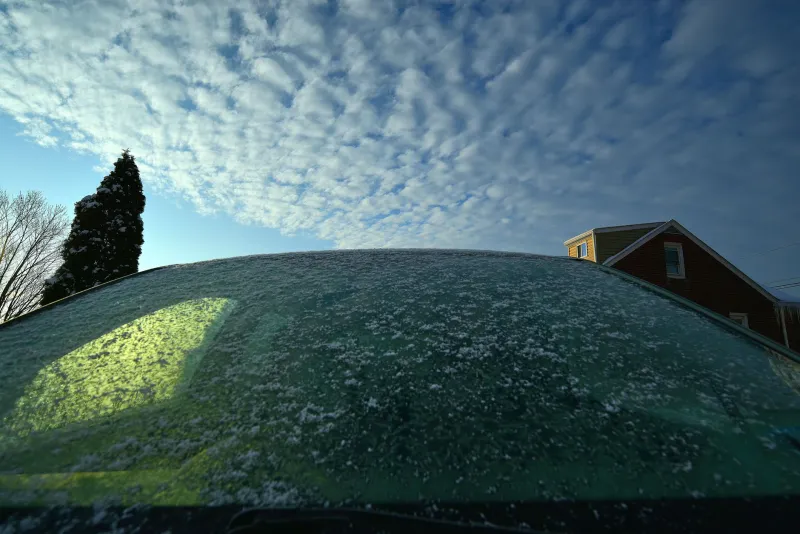
The first proper frost of November 2026 has a way of finding the smallest weakness in a London car. You go out early, scraper in hand, and there it is: a hairline crack running out from a chip you had been meaning to sort since the summer. Last week it was barely a speck. Now it is a line across the driver's side, and the MOT is booked for December.
This is not bad luck. It is physics, plus a bit of London grit, plus a heater turned up to maximum while the glass is still cold.
Why a frosty morning is hard on glass
A windscreen chip is rarely a clean little hole. It is a tiny break in the glass, often with a pocket of air and moisture trapped inside. When the temperature drops below freezing, that moisture expands. The glass around the chip is already stressed, and the expansion pushes at the edges of the damage. Do that once and nothing much happens. Do it night after night and the chip starts to travel.
Then comes the morning routine. You start the engine, put the heater on full, maybe hit the heated screen button, and the inside of the glass warms up much faster than the outside. Glass expands and contracts with temperature, and a chip is a weak point where that movement has somewhere to go. Add the twist and flex of a car pulling away over a speed bump or a poorly patched bit of road, and a small nick can become a crack before the kettle has boiled.
Pouring hot water on a frozen windscreen is the classic version of this mistake. It can crack glass on its own, even without a chip. Use de-icer, a scraper, or let the car's own demister do the work gently.
The London extras: grit, potholes and parked-up streets
London roads add their own ingredients. Gritters throw up small stones. Building works and badly surfaced side streets leave loose chippings. Narrow streets mean cars pass close to kerbs, and a clipped wing mirror or a stone flicked from a bus lane can leave a fresh chip that the driver never hears.
Cars that sit parked for days also go through bigger temperature swings. A windscreen can be freezing at dawn, then take weak winter sun later in the day. The glass and the body shell do not warm up at the same rate. A chip near the edge of the screen is especially vulnerable, because that is where the glass meets the bonding and the body flexes most.
And once a chip is open to the weather, London grime does the rest. Road salt, fine grit and rainwater work their way into the break. The repair becomes less effective, and the damage has more chance to spread.
What the MOT tester actually looks at
The MOT is not a beauty contest for glass. The tester is looking at whether damage affects the driver's view of the road. The inspection manual splits the windscreen into zones. Zone A is the central band in front of the driver, roughly 290mm wide. Damage in Zone A bigger than 10mm is a fail. In Zone B, which is the rest of the area swept by the wipers, the limit is around 40mm. Damage outside the swept area may be noted as an advisory rather than a fail, but it can still spread into a problem.
That is why a chip that looks trivial to you can be an MOT issue to a tester. Position matters as much as size. A small chip right in the driver's line of sight is treated more seriously than a slightly larger one tucked away near the passenger side. A crack with a sharp edge, or one that distorts the view, will also get attention.
If you are unsure, do not wait for the test. A repairer can tell you in minutes whether a chip is in a sensible place for resin repair or whether it is heading for replacement.
A street-side check before the kettle boils
You do not need a workshop to spot trouble early. Before you scrape the screen, stand outside and look across the glass at a low angle. Frost and dirt often highlight a chip that is invisible in daylight. Run a fingernail gently over the suspect spot. If your nail catches, there is a break in the surface. A small torch held at an angle can show the edges of a chip or the ends of a hairline crack.
If you find something, put a small piece of clear tape over it until you can get it looked at. That keeps water and grit out. Do not fill it with household glue. Do not ignore it because it is only small. And do not use the defroster on full blast straight away on a frozen screen with known damage. Warm the car gradually.
Repair, replace, or leave it?
A resin repair is usually the cheaper route. It injects a clear resin into the chip, pushes out the air, and sets under UV light. It will not make the chip invisible, but it can stop it spreading. Prices vary, but a simple repair is often far less than a new screen. Replacement is the sensible option when the damage is in the driver's central view, when a crack has grown too long, or when the break is near the edge of the glass.
Check your insurance before you book anything. Many comprehensive policies include windscreen cover, with a much lower excess for repair than for replacement. Some repairers will deal with the insurer directly. If you are paying yourself, ask for a written quote that separates repair and replacement, and ask what happens if the repair does not hold.
The diary trick that saves the bill
If your MOT is due in the next few months, deal with the chip now. A repair booked in November is a lot cheaper than a failed test, a replacement screen and a retest in December. Keep the receipt with your service history. It shows the damage was dealt with, and it helps if you ever sell the car.
At London Avenue Garage, we would rather see a driver for a small resin repair than a full replacement a fortnight later. Frost is quiet, patient and very good at finding the weakest point in a windscreen. A two-minute check on a cold morning is the simplest way to stop it doing its work.