Clunks, Knocks and Rattles: Reading the Noises London Roads Leave Behind
London roads have a language of their own. A pothole on a side street in Croydon, a raised speed cushion in Camden, a temporary patch on the A406—each one can leave a little signature under your car. Most of the time it is just a rattle from something loose. Sometimes it is the first note of a suspension job that will fail an MOT if you ignore it. The trick is knowing which noise deserves a kerbside look and which one should get you booked in at London Avenue Garage.
Start with a safe kerbside check
Before you start hunting for noises, park somewhere legal and flat. Switch off the engine, put the handbrake on and keep a torch handy if it is dark. Do not jack the car up at the side of a busy London road and do not crawl under it. A kerbside check is about tyres, visible parts and a gentle bounce or rock—not a full inspection. If you are on a red route or near a bus stop, move first. A five-minute check is not worth a ticket.
1. A sharp clunk over speed humps
A single clunk as the front wheels come off a hump often points to worn drop links or anti-roll bar bushes. These are cheap-ish components that take a beating on London's stop-start streets. You might hear it over small bumps at low speed, and it can sound worse when one wheel hits a bump rather than both. Drop links are common MOT advisory items. If the noise is paired with a knock when you turn the wheel, get it checked sooner.
2. A metallic twang or knock over potholes
A sharp metallic knock or twang after a pothole can be a broken or tired coil spring, a worn top mount or a loose heat shield. Springs can break near the end and still hold the car up, which is why the noise can come and go. Do not ignore a twang if the car also sits lower on one side. A broken spring is an MOT failure risk and can damage a tyre.
3. A low grumble or hum that changes with speed
This is less about potholes and more about what a pothole leaves behind. A wheel bearing can start humming after a hard hit, especially if the wheel took the impact at an angle. A buckled alloy can also cause a vibration or a thrum through the floor. Check the tyre sidewall for bulges and the rim for fresh scuffs. If the noise gets louder when you turn one way, book a wheel bearing check.
4. A dull thud and steering that feels vague
A thud over rough patches, plus steering that feels a bit loose or off-centre, can mean worn wishbone bushes, a tired ball joint or alignment that has been knocked out. London's potholes are good at messing with tracking. You might notice the steering wheel is no longer straight when you drive in a straight line, or the front tyres are wearing unevenly. Alignment is not just a comfort job; bad geometry eats tyres and can hide suspension damage.
5. A rattle over rough patches
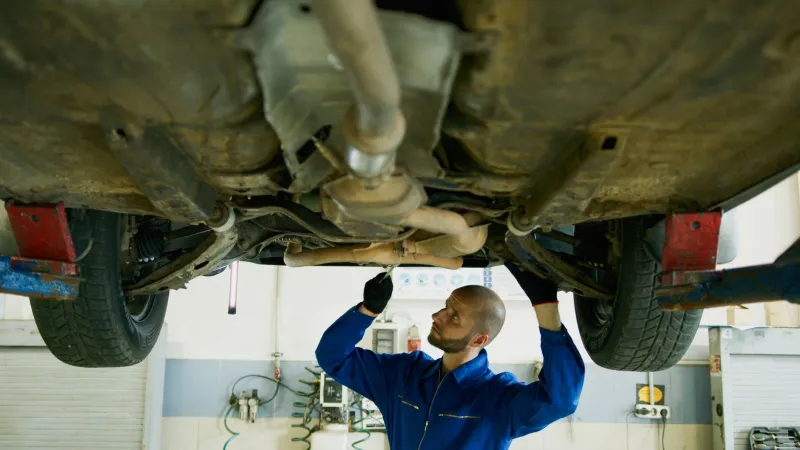
Not every rattle is expensive. A heat shield, a loose exhaust hanger, a brake pad that is moving slightly in the caliper or something rolling around in the boot can all sound alarming. Check the obvious first: empty the boot, look for loose trim and make sure nothing is rattling in the door pockets. Then look at the exhaust and heat shields from the side of the car, not underneath. If the rattle is metallic and follows engine speed, get it looked at.
What you can check at the kerb
Look at each tyre for cuts, bulges and objects stuck in the tread. Check the wheel rims for fresh dents or cracks. Press down on each corner of the car gently and listen—if it bounces more than once or clunks, note which corner. Check that the wheel bolts look undisturbed if you have recently had tyres changed. Do not loosen or tighten anything unless you know exactly what you are doing. Take a photo of any damage and note when the noise happens: braking, turning, going over humps or at a certain speed.
When to book a suspension or alignment inspection
Book a proper inspection if the noise repeats every day, if the steering pulls or feels vague, if a tyre is wearing on one edge, if you can see a bulge or a broken spring, or if your last MOT had an advisory for suspension, tyres or alignment. Do not wait for the MOT to fail. A small drop link knock is a simple fix; a worn ball joint or damaged tyre is not. London traffic is hard on suspension, and a pothole hit at 20mph can do more damage than a motorway bump at 60mph.
At London Avenue Garage, we would rather see a car with a new rattle than a car with a failed MOT and a flattened tyre. If you are not sure which noise you are hearing, bring it in and describe when it happens. A quick road test and a look on the ramp can save you guessing—and sometimes save you money.