Orange Discs and Slippery Kerbs: A November Braking Reset for London Cars
Somewhere between the third and fourth attempt to leave the residents' bay on a damp November morning, most London drivers notice it: the brake pedal feels different. Grainier. Noisier. Slightly less willing. The car has been sitting since Sunday evening, the plane trees along the road have been shedding steadily since October, and the first proper cold snap is still a fortnight away.
That first fifty metres of braking tells you more about your brakes than the rest of the commute put together. Here is what is going on, what you can safely do about it at the kerb, and where the line sits between a November quirk and a job for the garage.
Why this particular month is hard on brakes
Brake discs are bare cast iron. They are not painted, plated or protected, because they need friction to work. Leave one outside in damp air for a weekend and it will start to oxidise. That is not a fault, it is metallurgy.
November stacks several things on top of that. The air holds more moisture than it did in September. The roads are wet more often than dry. Fallen leaves collect in the gutters, against kerbs and under railway bridges, and the council leaf blowers move them from the pavement into the road, where they wait. And a lot of London cars do very little work: a short hop to the station, a school run, a weekly shop. Short, gentle trips do not get the brakes hot enough to dry them out or scrub the discs clean, so the film of rust has time to settle in.
Rear discs are the usual suspects. On a car that is mostly driven gently in traffic, the rear brakes contribute very little, which means they stay damp and lightly used for weeks. A rear disc that looks orange all winter is not necessarily broken, but it is worth watching.
Telling harmless film from real corrosion
The normal version looks like a thin, even, orange-brown haze across the whole braking face. Drive a mile with a few ordinary stops and it should disappear, or at least become patchy and then clear. The pedal should feel normal once it has gone.
The version that needs attention looks different. Look for:
- Pitting, flaking or a crusty edge on the disc face
- Deep concentric grooves or a visible lip on the outer rim
- One face rusty while the other is clean, a sign of a sticking caliper
- Blue or purple patches, which suggest overheating
- Rust that is still there after a week of normal driving
If any of those are present, the answer is not another commute. Book it in.
The wet-leaf factor
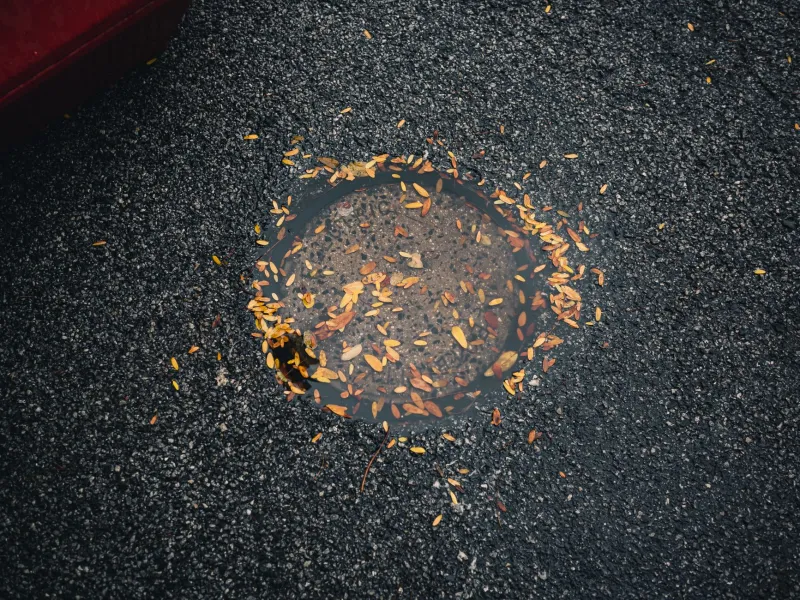
Leaves deserve their own section because they cause a different problem entirely. A wet leaf is slippery. A compressed layer of wet leaf mulch at the approach to a mini-roundabout or a box junction is genuinely slicker than most drivers expect, and it tends to sit exactly where you want to brake.
Treat a leafy patch the way you would treat ice: brake earlier, brake in a straight line, and do not combine braking with a turn. The car will not tell you the surface has changed until the pedal has already gone slightly long. On a cold, damp morning, that half-second of surprise is enough to put you over a give-way line.
A low-speed reset you can do safely
If the discs are just lightly rusted and the pedal feels fine once you have driven a mile, there is a simple routine that scrubs the film off evenly and re-beds the pads. It is not a performance exercise, and it should not be done in traffic.
- Find a quiet stretch, such as an empty industrial estate on a Sunday morning or a wide residential avenue, anywhere with good visibility and no reason to stop suddenly.
- From about 30mph, brake firmly but progressively down to roughly 10mph. Not a slam. Think of it as a firm, steady squeeze.
- Release and drive on for 30 seconds or so to let things cool a little.
- Repeat four or five times.
- Drive normally afterwards for ten minutes to let everything settle.
Do not sit at a standstill with hot pads clamped against hot discs. Do not hose them down. Do not try to clean them with one heroic stop from high speed on a fast dual carriageway. That is how you warp a disc and turn a free fix into a garage bill.
When to stop driving and call the garage
Some symptoms are not November quirks. If you notice any of the following, get it looked at before the next trip:
- A graunching or grinding noise that does not clear after a mile
- The car pulling to one side under braking
- A pedal that feels soft, spongy, or sinks slowly when you hold it
- Vibration through the wheel or pedal that was not there last month
- The handbrake needing noticeably more travel
- Brake fluid that looks dark, or is more than two years old
- Any brake warning light on the dash
A soft pedal, in particular, is not something to monitor. It usually means air or fluid loss somewhere in the system, and it can get worse quickly.
The ten-second November habit
Before you drive off, glance through the spokes of each wheel. You are not looking for perfection, you are looking for a change. Check the fluid level under the bonnet once a month. On the first mile of any journey, listen, and notice how the pedal feels when you first use it.
That is the whole routine. Ten seconds, once a week, through the winter. It will not stop the discs going orange overnight, because nothing will. But it will tell you the difference between a car that needs a mile of driving and a car that needs a ramp, and it means the first freeze will not be the first time you have thought about your brakes since the clocks went back.