The Slow Sip: What's Draining Your Battery While Your Car Sits in London

There's a particular London morning that starts with a click rather than a crank. You turn the key or press the button, the dash lights flare, and then everything fades to a weak flicker. The battery was fine last week. The car has been parked outside the flat since Friday. And somewhere in the boot or behind the mirror, a small gadget has been awake the whole time, taking tiny sips from a battery that never really got topped up in the first place.
Dash cams are the classic culprit, especially the ones with a parking mode. Add a tracker fitted for insurance, a phone charger left in the 12V socket, or an aftermarket stereo with a standby light, and the drain adds up. None of these things is necessarily faulty. They are just doing their job while the car is doing nothing.
The usual suspects are smaller than you think
A dash cam in parking mode might draw a few milliamps when it is waiting for a bump or movement. In event mode it wakes up, records, and goes back to sleep. That sounds harmless, and on a car that is driven daily it often is. On a car that sits for four or five days at a time, those milliamps become a steady withdrawal from a limited account.
Trackers are similar. So are alarm systems, keyless-entry receivers and any accessory wired straight to the battery rather than through the ignition. A charger left plugged into a live socket can draw a small amount even when no phone is attached. A boot light that stays on because the latch is slightly out of adjustment is less subtle, but it is easy to miss in daylight.
The awkward part is that London parking makes all of this harder to notice. You walk away, the car locks, and the drain carries on quietly under the streetlight.
Why short city trips make the sip worse
A battery does not fully recharge in five minutes of stop-start traffic. It takes a decent run, with the engine turning and the alternator doing its job, to put back what the starter motor took out. If your week is a series of two-mile hops between school, shop and station, the battery may never get back to full. Add a cold November morning and the chemistry slows down just as the demand goes up.
This is the London pattern: low mileage, frequent starts, lights and wipers on, heated screens working, and a dash cam recording every kerb-side nudge. The battery is not being asked to do anything dramatic. It is being asked to do a lot of small things without a proper rest and recharge.
The warning signs before the no-start
A flat battery rarely announces itself with a single clear symptom. You might notice the engine turning over more slowly than usual, especially on the first cold start. The dash cam might shut down earlier than it should, or the parking-mode footage might have gaps. Warning lights can flicker briefly when you start up. Keyless entry might take two presses instead of one.
Some cars show a battery symbol or a message about low battery charge. Others simply become grumpy. If you have a voltage display on a dash cam or a battery monitor, a resting voltage in the low 12s or below after a night parked is worth investigating. Do not rely on that alone, though. Voltage tells you something, but it does not tell you the whole story about battery health or charging.
What a garage should actually test
A proper check is more than putting a multimeter across the terminals and saying 'it looks alright'. At a garage, the first step is usually a battery health test with a conductance or load tester. That gives a better idea of whether the battery can still hold and deliver charge, not just whether it has some voltage left this morning.
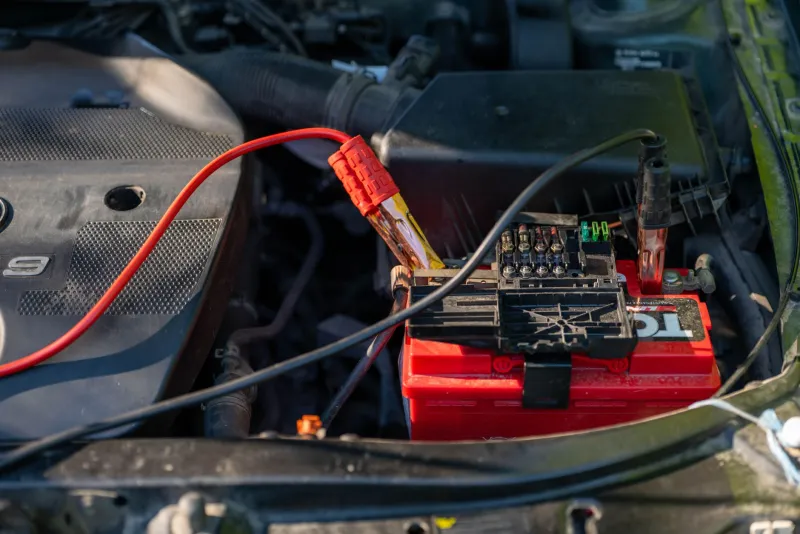
The charging system needs checking too. If the alternator is not putting out enough, or the belt and connections are tired, the battery is being asked to run the car and the accessories on borrowed time. A parasitic draw test is the next piece. That involves measuring current with everything switched off and the car gone to sleep, then working out whether the drain is within a normal range or whether something is staying awake.
Modern cars can take a while to fall asleep after locking, so this is not a five-second job. A garage may need the car for a few hours, or even overnight, to get a clean reading. If a dash cam or tracker has been hard-wired, the installer's work should be checked as well. A poorly chosen fuse tap or a missing voltage cut-off can turn a useful gadget into a battery tax.
Small habits that help
If your dash cam has a parking-mode voltage cut-off, use it. Set it high enough to leave the car with a comfortable margin for starting. Turn off parking mode if the car is going to sit for a week. Unplug chargers when they are not in use. If you mostly do short trips, give the car a longer run now and then, ideally with as few electrical loads on as possible.
None of this is about blaming gadgets. A dash cam can be genuinely useful on a London street, and a tracker may be an insurance requirement. The point is to match the kit to the way the car is used, and to catch a battery that is fading before it leaves you stranded outside the MOT station.
A flat battery is not usually an MOT failure in itself, but a car that will not start is a missed appointment, a recovery call and a day rearranged. If your car has been sitting more than usual, or the starter has lost its old snap, get the battery and charging system checked properly. It is a small test now, and a much better morning later.