Cold Morning, Crocodile Clips: Jump-Starting a Modern Car on a London Street
There is a particular kind of London morning that begins with a click, a dim dashboard and a quiet sense of doom. You are wedged into a residents' bay, there is a bin lorry somewhere behind you, and the car that started perfectly well on Sunday has decided that Tuesday is not for it. Jump-starting sounds simple — two cars, two leads, away you go. On a modern car, though, it deserves a bit more thought.
This is not about being precious. It is about not frying a control unit, not upsetting a stop-start system, and not standing in the road with crocodile clips while a bus tries to get past. If you are going to do it, do it properly. If it is not that kind of no-start, call the garage instead.
First: is it actually a flat battery?
A flat battery usually gives you a slow, tired crank, dim lights, a clicking starter and maybe a flicker of dashboard lights that fade as you turn the key. A failed starter, a keyless fob problem or a fuel issue can feel similar from the driver's seat, but jumper leads will not fix those.
Before you unpack anything, check the obvious. Is the car in Park or Neutral? Is the clutch pressed if it is a manual? Has the keyless fob got a flat button cell? Is there enough fuel? And is the battery itself damaged — cracked case, swollen sides, leaking acid, or a smell of rotten eggs? If any of that is true, stop. Do not jump it. That is a recovery or garage job.
Also check the handbook. Modern cars vary enormously. Some have jump-start terminals under a plastic cover, some hide the battery under the boot floor or a seat, and some — especially hybrids and EVs — have very specific instructions about where and whether you should connect anything. A 30-second look in the glovebox manual is cheaper than a new inverter.
Pick your spot like you mean it
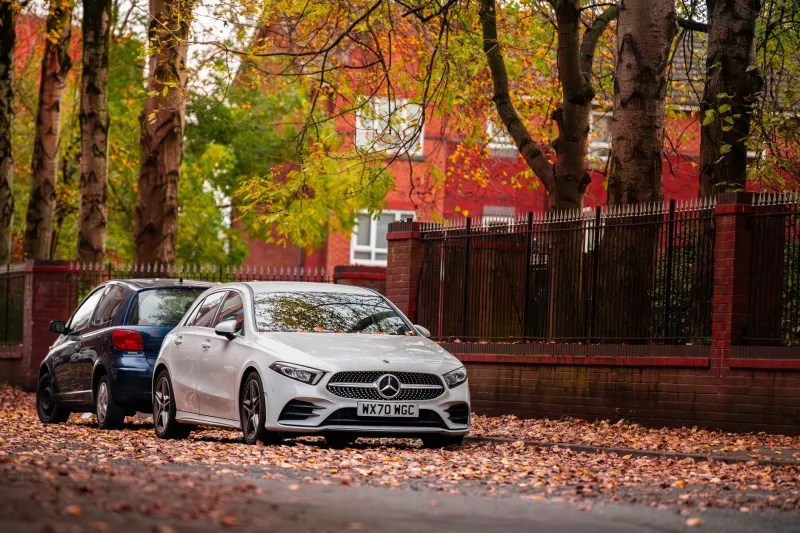
A jump start needs two cars close enough for the leads to reach, but not touching. On a London street, that is the hard part. Avoid bus lanes, zebra crossings, corners, cycle lanes and anywhere you would be forcing pedestrians into the road. If you are in a residents' bay, check you are not about to block someone in.
Do not let the two cars touch bodywork. Do not stand between them. And keep leads away from fans, belts and hot exhaust parts. If the only place you can safely park is in the middle of a busy road, it is not a safe place to be leaning over an engine bay. Call for help or a jump pack instead.
The lead order that keeps everyone happy
Assuming both cars are conventional petrol or diesel, the battery is healthy-looking and the handbook gives the all-clear, the sequence is:
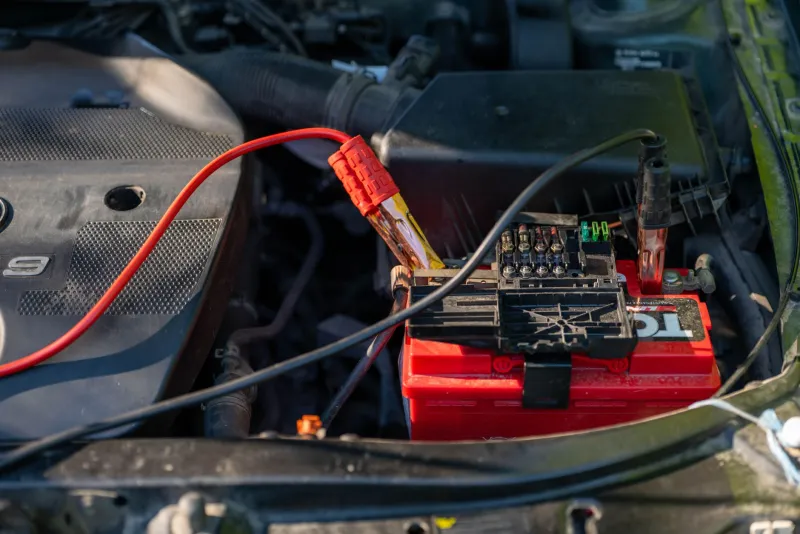
- Red lead to the positive terminal on the flat battery.
- Other end of the red lead to the positive terminal on the donor battery.
- Black lead to the negative terminal on the donor battery.
- Other end of the black lead to a solid metal earth point on the flat car — an engine lifting eye or a dedicated earth point, not a painted bracket and not the negative battery post on many modern cars.
That last point matters. Lots of modern cars have a battery sensor on the negative post, and clipping straight onto it can confuse the battery management system. The handbook will usually show the correct earth point. If it does not, and you are not confident, use a jump pack instead.
Start the donor car if it is a conventional car, let it run for a minute, then try the flat car. Do not crank for ten seconds at a time. Give the starter a rest between attempts. Once it fires, leave both cars running for a few minutes, then disconnect in reverse order: black from the earth point, black from the donor, red from the donor, red from the flat car.
Stop-start, AGM and the modern battery trap
If your car has stop-start, it very likely has an AGM or EFB battery. These are not the same as the old lead-acid lump you might remember from a first car. They cope with repeated deep cycling, but they also need proper charging. A short jump start might get you moving, but it will not necessarily put the battery back into a healthy state.
After a jump start, do not just idle on the driveway for five minutes and call it done. Take the car for a proper drive — 20 to 30 minutes at normal speeds, not stop-start crawling through traffic — so the alternator can do its job. Even then, an AGM battery that has been flattened may need a garage charger that is compatible with its chemistry. A cheap old charger can do more harm than good.
If the car has stop-start and the battery is on its way out, you may also see the stop-start system refusing to work, or a battery warning light that comes and goes. That is the car telling you something. Do not ignore it until the next cold snap.
When it is really a garage moment
Jump-starting is a roadside kindness, not a diagnosis. Call the garage if the car will not start even with a good donor battery, if it starts and dies immediately, if there is a fuel smell, if the dashboard is lit up like a Christmas tree, or if the battery has been flat more than once in a few weeks. Repeated flat batteries usually mean a parasitic drain, a failing alternator or a battery that has simply had enough.
The same goes for EVs and hybrids. Some can be jump-started from a 12-volt slave battery, but the procedure is specific and getting it wrong is expensive. Check the handbook or call someone who knows the model.
And if you are on a red route, in a bus lane or blocking a junction, do not make a bad situation worse. A jump pack, a recovery driver or a garage call-out is often the more London-appropriate answer. The pavement jump is a useful skill, but knowing when to put the clips down is the real one.